Publication & Reports


Informing Policies, Reforming Practices.

Report on Sight for success- Leveraging the private sector for disability inclusion in learning - KP and Punjab

This report presents the "Sight for Success" innovation, which leveraged local private sector CSR to address vision impairments among school children in Punjab and KP. Through a pilot vision screening in 40 schools, over 755 students with vision problems were identified, with 74% receiving eyeglasses, while the initiative also developed institutional frameworks, including a local CSR framework, PTC guideline amendments, and an integrated referral pathway, to sustainably scale school health interventions.
B-TAG inception report cover

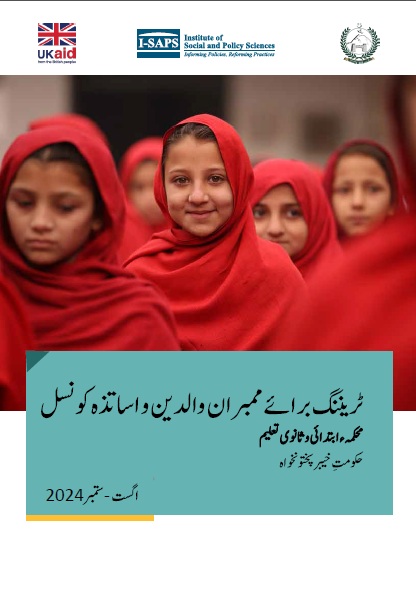
Training Manual for PTCs - Khyber Pakhtunkhwa

This training manual equips Parent-Teacher Council (PTC) members in Khyber Pakhtunkhwa with knowledge and skills to improve school governance, increase enrollment, promote inclusion, and mobilize resources. It covers six key areas through participatory methods, including school management, climate resilience, dropout reduction, safeguarding, and community engagement.

B-TAG inception report cover

Technical Guidance Report on School Improvement Framework (SIF) (Punjab)

This report analyzes the School Improvement Framework (SIF) in Punjab, identifying structural, operational, and financial challenges that hinder its effective implementation. It provides phased recommendations, immediate actions to enable rapid operationalization, and interim measures to strengthen institutions to revitalize SIF as a data-driven tool for targeted school support and evidence-based decision-making.

Inter-Provincial Coordination Conference report cover

Afternoon Schools Study - Punjab

This report evaluates Punjab's Afternoon Schools Programme (ASP), which enrolls over 273,000 out-of-school children in middle-level classes through the use of existing primary school infrastructure. TALEEM-run ASP schools, with teacher training, timely salaries, and monitoring, outperform regular middle schools, highlighting that implementation quality is key to programme success.

KPCPD

Study on Double Shift Schools - Khyber Pakhtunkhwa

This report evaluates Khyber Pakhtunkhwa's Double Shift Schools (DSS) program, which expanded enrollment from 25,765 to 69,109 students (2022-2024), particularly benefiting girls. However, challenges include declining functional schools, resource inequity, and governance gaps, with recommendations for policy revision, better monitoring, and expanded girls' education in underserved areas.

MGT Punjab

Political Economy Analysis of Teacher Licensing and Certification in Punjab

This political economy analysis assesses the feasibility of teacher licensing and certification in Punjab, finding that success hinges on phased implementation, inclusive stakeholder dialogue, and linking licensing to professional development rather than punitive measures. It recommends a regulated hybrid delivery model to balance credibility with institutional capacity while navigating powerful teacher unions and historical reform resistance.

KP-CRSF

Political Economy Analysis of Teacher Licensing and Certification in Khyber Pakhtunkhwa

This political economy analysis assesses teacher licensing feasibility in Khyber Pakhtunkhwa, finding that success requires navigating fragmented bureaucracy, powerful unions, and informal transfer practices. It recommends a phased approach framing licensing as professional recognition, starting with new teachers and subject specialists, while embedding reform within existing systems and ensuring equity for women and merged district teachers.

CRS - Provincial Guidelines